
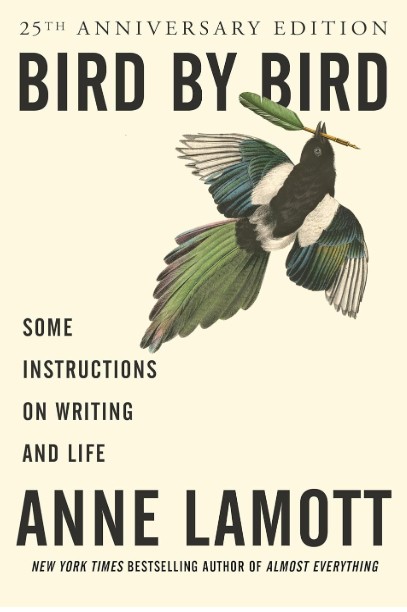
“Bird by Bird” by Anne Lamott is much more than a writing manual. It is a book about the psychology of writing, how to overcome fear, perfectionism, self-doubt, and procrastination. Lamott believes that good writing comes from honesty, patience, observation, and the willingness to write badly before writing well.
“Writing takes a combination of sophistication and innocence; it takes conscience, our belief that something is beautiful because it’s right. To be great, art has to point somewhere. So, if you are no longer familiar with that place of naive conscience, it’s hard to see any point in your being a writer.”
What I learned from the book:
- Take it “Bird by Bird”
The title comes from a childhood memory. Anne’s brother had to write a report on birds and felt overwhelmed. Their father told him:
“Bird by bird, buddy. Just take it bird by bird.” Don’t think about finishing the whole novel or story. Focus on the next sentence, the next paragraph, the next scene. Every large project becomes manageable when broken into small pieces.
E. L. Doctorow once said that “writing a novel is like driving a car at night. You can see only as far as your headlights, but you can make the whole trip that way.”
- Write terrible first drafts.
This is the book’s most famous advice.
Lamott argues that every good writer begins with a bad first draft. The first draft isn’t supposed to be beautiful. It is meant to exist.
She encourages writers to silence their inner critic and get words onto the page. Editing comes later.
- Perfectionism is the enemy.
Perfectionism stops people from writing.
If you wait until every sentence is perfect, you will never finish anything. Lamott believes progress matters far more than perfection. Imperfect work can always be improved; a blank page cannot.
- Observe the world carefully
Writers must be great observers. Notice details that others ignore.
Listen to conversations.
Watch people’s gestures.
Remember smells, sounds, and emotions.
Great writing comes from close observation rather than a huge imagination alone. Ordinary life contains extraordinary stories.
- Tell the truth
According to Lamott, readers recognize honesty. Whether writing fiction, memoir, or essays, the emotional truth must be real. She encourages writers to be vulnerable instead of trying to impress others.
- Build your own style
To be a great writer, you have to be a voracious reader. Read widely, learn from your favorite authors, but gradually develop your own style. Your unique voice is your greatest strength.
“Books help us understand who we are and how we are to behave. They show us what community and friendship mean; they show us how to live and die.”
- Write about what you know deeply
Lamott advises beginning with familiar experiences. A small, specific memory is often more powerful than trying to write about grand ideas. She even suggests imagining a tiny “one-inch picture frame” and describing only what fits inside it.
- Accept fear and self-doubt
Fear never disappears.
Professional writers also worry that they aren’t talented enough.
The difference is that successful writers continue writing despite the fear.
- Characters should be real people
Instead of creating perfect heroes and villains, give characters contradictions, weaknesses, dreams, and flaws. Readers connect with imperfect human beings.
- Writing is rewriting
The first draft creates the material and revision shapes it. Lamott emphasizes that much of the good writing happens during editing, when unnecessary words disappear, and the true story emerges.
- Writing is more important than publishing
Many beginners dream only of publication.
Lamott reminds readers that publishing will not magically make them happy. The real reward is the act of writing itself: the joy of discovery, expression, and connection with others.
“An author makes you notice, makes you pay attention, and this is a great gift. My gratitude for good writing is unbounded; I’m grateful for it the way I’m grateful for the ocean.”
- Build discipline
Inspiration is wonderful, but writers cannot wait for it every day. You have to be consistent in your job. Small daily efforts mean a lot.
One of the book’s greatest lessons
The deepest lesson of “Bird by Bird” is that writing is not merely producing words; it is discovering yourself.
Lamott believes you do not always know what you think until you write it. Writing helps you understand your memories, your fears, your relationships, and your place in the world. The goal is not simply to create a manuscript and wait for it to d be published, but to become a more attentive, compassionate, and truthful observer of life.
“Bird by Bird” by Anne Lamott is often considered one of the most encouraging books for aspiring writers. It teaches that great writing is built not on talent alone, but on patience, honesty, and the courage to keep writing one “bird” at a time.

