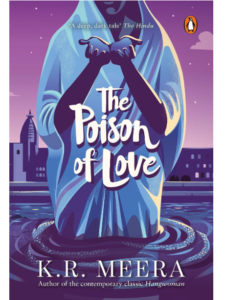
K. R. Meera, an eminent Indian author and journalist who writes in Malayalam and is known for famous novels such as The Gospel of Yudas and Hangwoman, is once again sparkling with unique vivacity in The Poison of Love. Translated by MINISTHYS, the book stands out for its cover design and interior decoration.
Storyline:
‘Love is like milk. With the passage of time, it sours, splits, and becomes poison.’ The opening echoes the novel’s theme: bitter love and self-abolishing vengeance. Tulsi, a highly ambitious IIT girl with record marks, falls in love with Madhav, who already has 27 love affairs behind Tulsi’s back and many more after they become conjugally close.
Madhab was irresistible with his passion. In his debonair pose, unfathomable mystery lurks in his compassionate eyes and sculpted appearance. Tulsi could not avoid the charm. She yielded to his manipulative provocation. She eloped the day before her marriage, leaving her highly commanding father, cancer-ridden mother, and two younger sisters’ fate at stake. She, for the sake of her love, destroyed every life associated with her. She even poisoned her two kids when Madhav sought a divorce to marry Bhama. She agrees with his request but entreats Madhav for the last consummation in that bed. ‘The kids will wake up. ‘Oh, no! They will not be waking up.’ She promised her kids, her dead kids, ‘We have to leave him before he can abandon us. We have to purify your father with the pain of separation.’ And that she did. With a tonsured head and a poisoned heart, she became the Meera, Meera mai of Mathura. She waited for her vengeance for long twelve years to meet desolated, abandoned, paralyzed Madhav. Her vengeance was complete, and she now seeks wounds for her own sake. ‘I needed wounds. To hurt me more grievously, I needed more wounds.’
Dark humor and deep pathos loom large on every page of the novel, and the feeling of agony crawls like ants that set their track through the pages of the book, the corpse eater. If Madhav is the Krishna figure, Tulsi must be the embodiment of the gopis, though she aspires to Meera. In terms of character portrayal, a neatly connected storyline, and an ever-lingering tone of anticipation, the novel reaches its highest paradigm. The ending subdued the emotion that tormented the novel throughout, first raising it to the catastrophic heights of pity and fear, then dimming it with blood and pain.
Final Verdict:
From the beginning to the end, the novel keeps me glued to my seat. As I read, I bleed, bleed for Tulsi, for thousands of Tulsis, and for Kanna and Unni, two of Tulsi’s children. It is a powerful story that opens every lock of emotion, giving one utmost pleasure and pain at the same time.



Pingback: White Noise, Shruti Upadhaya, Book Review, Dark Romance